Stop Bonking: A Simple Fueling Formula for Long Weekend Rides
That horrible hollow feeling 90 minutes into a big ride? It's not bad luck — it's bad fueling. Here's a simple, ride-length formula that keeps your legs turning and your brain functioning all the way home.
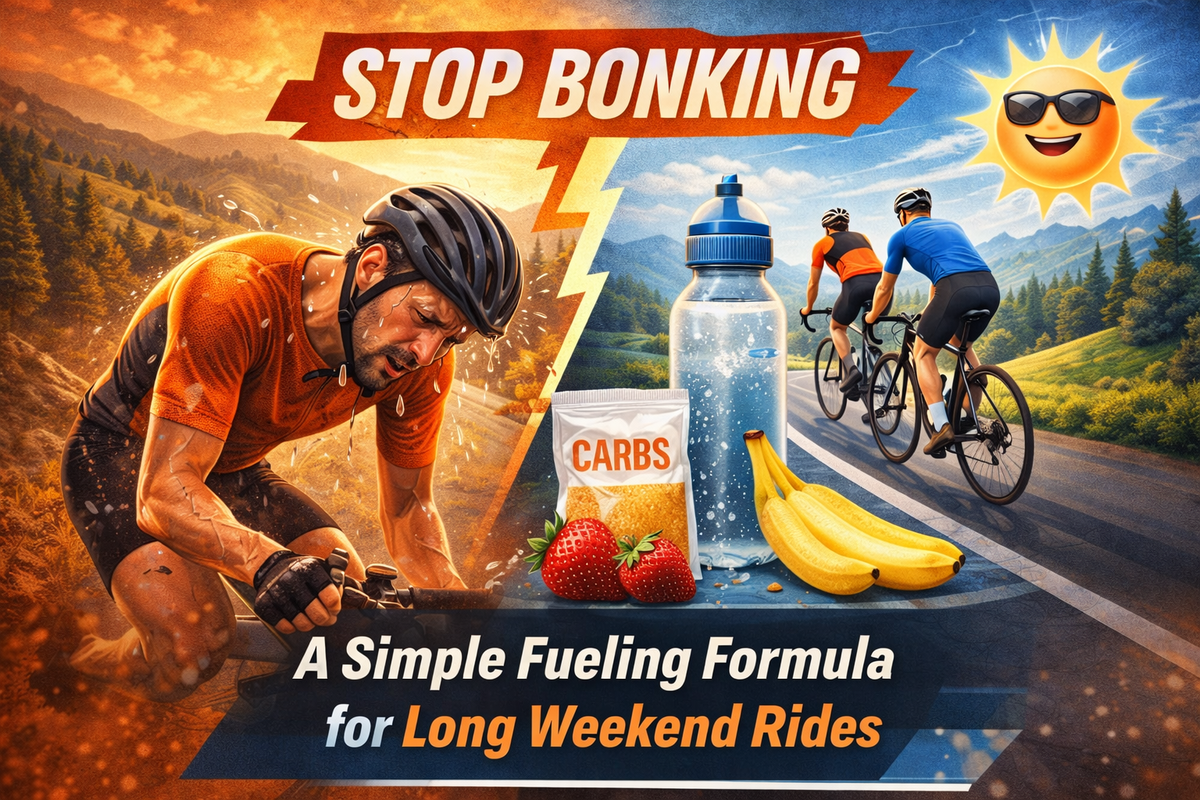
What "Bonking" Really Is (and Why It Keeps Happening)
Every cyclist who's ridden long enough has experienced it: the sudden, catastrophic loss of energy that turns your legs into concrete blocks and your brain into porridge. One minute you're tapping along nicely; the next you're staring at a gentle incline as though it's Alpe d'Huez and seriously considering whether you could hitch a lift home in someone's boot.
That's a bonk. And it's not a mystery — it's glycogen depletion.
Your muscles and liver store around 600 grams of glycogen — roughly 2,400 calories of readily available carbohydrate fuel. At moderate-to-hard cycling intensity, you burn through 120 to 180 grams of that per hour. Do the maths and you'll see why things go wrong after 90 to 120 minutes without eating: your tank runs dry. Once muscle glycogen drops critically low, your body can still oxidise fat for fuel, but fat can't sustain the same power output. The result is that distinctive bonking feeling: legs that refuse to push, a head that can't think straight, and a profound desire to lie down in a hedge.
The reason it keeps happening to otherwise sensible riders is simple: most people don't eat enough, early enough. "I'll see how I feel" is the unofficial motto of every cyclist who's ever crawled home an hour slower than planned. By the time hunger arrives, glycogen stores are already critically low — and eating a gel at that point is like throwing a cup of water on a house fire. Too little, too late.
The fix isn't eating more. It's eating sooner, and matching your intake to the length and intensity of the ride. Which brings us to the formula.
The Simple Fueling Formula by Ride Length
Sports science has made this refreshingly straightforward. The amount of carbohydrate you need per hour depends primarily on how long you'll be riding. Here's the framework, based on current guidelines from the International Society of Sports Nutrition and researchers like Asker Jeukendrup:
Under 90 minutes: You don't strictly need to eat anything. Your glycogen stores can handle it. If the session is hard — a crit, a time trial, a punchy club run — a carbohydrate mouth rinse (swishing a sports drink around your mouth and spitting it out) can provide a small central nervous system boost without the digestive overhead. But for most sub-90-minute rides, water is enough.
90 minutes to two hours: Start fueling. Aim for around 30 grams of carbohydrate per hour. That's one energy gel, or 500 millilitres of a standard sports drink, or a banana. It's a small amount — just enough to top up what you're burning and prevent the slide towards empty.
Two to three hours: Step it up to 40 to 60 grams per hour. This is where most weekend club rides and shorter sportives sit. A single carbohydrate source — glucose or maltodextrin — is fine here, because your gut can absorb around 60 grams per hour through one intestinal transporter. In practical terms, that's a gel plus half a bottle of sports drink per hour, or an energy bar and regular sipping.
Three to five hours: Now you need 60 to 90 grams per hour, and ideally from multiple carbohydrate sources. This is the territory of long sportives, big training days, and the kind of rides that define a summer. Your intestine has two separate carbohydrate transporters: one for glucose (and maltodextrin), another for fructose. Use products that combine both in a roughly 2:1 or 1:0.8 ratio and your gut can absorb up to 90 grams per hour — far more than either source alone. Research shows this dual-carb approach can improve performance by up to eight per cent on long efforts compared to glucose-only fueling.
The numbers might feel abstract, so let's make them concrete. A standard SiS GO gel contains 22 grams of carbohydrate. A High5 Energy Gel has 23 grams. A SiS Beta Fuel gel packs in 40 grams using a dual-carb formula. A 500-millilitre bottle of SiS GO Energy drink delivers about 47 grams. A banana provides roughly 27 grams. Mix and match to hit your hourly target, and you've got a fueling plan.
Pre-Ride Breakfast and Top-Up Snacks
What you eat before the ride matters almost as much as what you eat during it. The goal is to top up liver glycogen (which depletes overnight while you sleep) and provide a stable foundation of blood glucose for the first hour of riding.
Aim for two to three grams of carbohydrate per kilogram of body weight, eaten two to three hours before you roll out. For a 70-kilogram rider, that's 140 to 210 grams of carbohydrate — a proper breakfast, not a quick coffee and a biscuit.
Good options:
A large bowl of porridge made with milk, topped with a sliced banana and a drizzle of honey. That's roughly 100 grams of carbohydrate — add a glass of orange juice and a slice of toast with jam to push it towards 150. Two bagels with peanut butter and banana get you to around 120 grams. If you're an early starter and can't face a big meal at 6am, a smoothie made with oats, yoghurt, banana, and honey is easier to get down and delivers 80 to 100 grams of carbohydrate in a format your stomach won't argue with.
Research suggests that lower glycaemic index breakfasts — porridge rather than white toast, for instance — provide more sustained energy release, which matters most when you're not planning to fuel aggressively on the bike. If you're following the fueling formula above and eating regularly during the ride, the GI of your breakfast matters less.
For rides starting mid-morning or afternoon, eat your main meal two to three hours before and add a small top-up snack 30 to 45 minutes beforehand: a banana, a rice cake with jam, or a small energy bar. Nothing heavy, nothing with lots of fibre or fat — just a gentle nudge to your blood sugar before the effort begins.
On-Bike Fueling You Can Actually Stick To
Knowing how much to eat is one thing. Actually doing it while riding is another. The most common failure isn't ignorance — it's forgetting. You get chatting in the group, or the climbing starts, or you're enjoying the scenery, and suddenly an hour has passed without a mouthful.
Set a timer. It sounds painfully simple, but it works. Programme a repeating alarm on your bike computer or watch every 20 to 30 minutes. When it beeps, eat or drink something. The specifics matter less than the habit. Gel, bar, sports drink, banana — whatever you've packed, get it in on schedule.
A good rhythm for a three-hour ride looks something like this: take your first fuel at 30 to 45 minutes (before you feel any need for it), then eat something every 30 to 45 minutes after that. Alternate between drinks and solid food to keep things varied and reduce the chance of flavour fatigue. On the opening hour, solid food — bars, rice cakes, a flapjack — sits well because the intensity is usually manageable. Later in the ride, as efforts increase or fatigue sets in, gels and liquid carbs tend to go down more easily.
There's also encouraging science on gut trainability. If you've ever felt nauseous eating on the bike, your digestive system probably isn't used to processing fuel at intensity. The fix is practice: start with comfortable amounts (30 grams per hour) and increase by about 10 grams per hour each week during training rides. Over six to ten weeks, your gut adapts — gastric emptying speeds up, intestinal absorption improves, and what once felt stomach-churning becomes second nature. Train your gut the way you train your legs: progressively, consistently, and with patience.
Hydration: Enough Fluid Without Living in the Bushes
Fueling and hydration work together. Carbohydrate absorption in the gut is enhanced by sodium, and sodium absorption requires fluid. Get one wrong and the other suffers.
The baseline recommendation is 400 to 800 millilitres of fluid per hour, adjusted for temperature, intensity, and your personal sweat rate. In practical terms, that's one standard 500-millilitre bottle every 40 to 75 minutes for most riders in British conditions. On a proper hot day — the kind where the tarmac shimmers and your arms are burning by the second hour — push towards the higher end.
Sodium intake should sit around 500 to 700 milligrams per hour on rides longer than two hours. Most commercial sports drinks contain 300 to 500 milligrams per 500-millilitre bottle. If you're a salty sweater (you know who you are — the white tide marks on your black jersey give it away), consider adding an electrolyte tablet or switching to a higher-sodium drink like those from Precision Fuel & Hydration.
One important ceiling: research shows that pushing sodium above 900 milligrams per hour provides no additional performance benefit and can increase nausea. More isn't always better.
The simplest hydration strategy is to carry one bottle of plain water and one of sports drink. Alternate between them. If you're using gels for carbohydrate, wash them down with water rather than sports drink to avoid creating an overly concentrated sugar solution in your stomach. And for rides over three hours, know where your refill points are — café stops, village taps, or friendly marshals at sportive feed stations.
Common Mistakes That Kill Your Ride
Going too hard in the first hour. This is the silent fuel killer. Hammering the opening 30 minutes because you feel fresh depletes glycogen at a dramatically faster rate than steady pacing. At high intensity, you can burn through 120 to 180 grams of glycogen per hour — at moderate pace, more like 80 to 100. That difference compounds over three or four hours. The riders who feel strong at the finish are the ones who held back at the start.
Starting under-fueled. Skipping breakfast, or eating something tiny two hours before a big ride, means you begin with a glycogen deficit you'll never recover from on the bike. Eat properly before you leave the house.
Waiting until you're hungry. By the time your body sends a hunger signal during exercise, you're already deep into glycogen depletion. Eating a gel at this point helps, but it takes 15 to 20 minutes for that carbohydrate to reach your bloodstream. If you'd eaten it 30 minutes earlier, you'd never have hit the wall in the first place.
The café stop trap. Stopping halfway through a ride for a bacon sandwich and a slice of Victoria sponge is one of cycling's great pleasures. It's also a nutritional ambush. Fat and fibre slow digestion dramatically, meaning the carbohydrate from that flapjack won't be available for another hour or more. If you're stopping mid-ride, choose simple carbohydrates — jam on toast, a sports drink, a gel — that your body can use quickly. Save the cake for after.
Testing new products on a big day. Your gut is particular, and it doesn't appreciate surprises. That gel you've never tried before might be the one that gives you cramps at kilometre 80. Test everything in training. Establish a kit of products your stomach trusts, and stick to it on event day.
Sample Fueling Plans for Three Classic Weekend Rides
The 2.5-Hour Endurance Loop
Breakfast: porridge with banana and honey, two to three hours before (roughly 100 grams of carbohydrate). On the bike: start eating at 30 to 45 minutes. One gel at 45 minutes, then one every 40 to 45 minutes after that. Sip a 500-millilitre bottle of sports drink steadily throughout. Total on-bike intake: approximately 130 to 150 grams of carbohydrate (about 50 to 60 grams per hour). Product example: two to three High5 Energy Gels (23 grams each) plus 500 millilitres of SiS GO Energy drink (47 grams).
The 3-Hour Club Ride with Efforts
Breakfast: two slices of toast with peanut butter and jam, plus a glass of juice, two to three hours before (roughly 85 grams of carbohydrate). On the bike: first gel at 45 minutes, then alternate between gels and solid food every 30 to 40 minutes. Take a bite of an energy bar during easier sections; save gels for the hard efforts and climbs where chewing isn't practical. Sip from a sports drink bottle throughout. Total on-bike intake: 120 to 140 grams of carbohydrate (40 to 47 grams per hour). Product example: two to three High5 gels, one Torq or Clif bar (30 to 45 grams), and 500 millilitres of SiS GO Energy drink.
The 4–5 Hour "Big Day Out" Sportive
Breakfast: large bowl of porridge with banana, honey, and juice, three hours before (roughly 100 grams of carbohydrate). On the bike: aim for 60 to 80 grams of carbohydrate per hour using dual-carb products. Start with a SiS Beta Fuel gel (40 grams) at 45 minutes, then rotate between gels, bars, and sports drink every 30 minutes. Use a 500-millilitre bottle of Maurten Drink Mix 160 (40 grams) alongside gels for the heaviest fueling hours. Total on-bike intake: 280 to 310 grams of carbohydrate across four to five hours. Carry two bottles plus a soft flask; refill at feed stations. Practise your nutrition strategy on training rides beforehand — this is too much food to wing on race day.
Tracking What Works for You
The formula above is a starting framework. Your body is the experiment.
Individual variation in carbohydrate absorption is enormous — some cyclists comfortably oxidise 90 grams per hour, while others hit digestive trouble at 50. The only way to find your sweet spot is to test systematically and record what happens.
Start a simple fueling log. After each ride, note: what you ate and drank (with approximate grams of carbohydrate), when you ate it, how your energy felt in the final third of the ride (on a one-to-ten scale), and any digestive issues. You don't need a spreadsheet — a note on your phone works fine.
Over six to ten weeks, a pattern emerges. You'll discover which products your stomach prefers, how much you can tolerate at intensity, and whether your sweet spot is closer to 40 grams per hour or 80. You might find that gels work perfectly on the turbo but make you queasy on a hot outdoor ride, or that real food sits better than sports products for the first two hours but becomes hard to face after that.
If you want to take it further, services like TrainingPeaks now offer fueling insights that tie your carbohydrate intake to power and duration data. And for riders who like precision, exogenous carbohydrate oxidation testing — which measures how much ingested carbohydrate your body actually uses during exercise — is becoming increasingly accessible.
But you don't need any of that to stop bonking. You just need the formula, a timer on your handlebars, and the discipline to eat before you're hungry. Your legs — and the riders waiting for you at the café — will thank you.